November 8, 2026
When this post was last updated, the AI cheating detection scene was a year into its hype cycle. OpenAI had shipped its own classifier and then withdrawn it within months on accuracy grounds, while GPTZero was still a Princeton student’s side project barely a year old. Most of the other tools on the market were unbranded sites with no track record to speak of.
Nearly three years later, the industry has turned over completely, and the provisional feeling that defined 2024 is gone. GPTZero grew into a company valued at over $88 million, according to PitchBook data cited by Business Insider (2026), and was acquired in June 2026 by Superhuman, the productivity company formerly known as Grammarly. At least one of the tools profiled in the earlier version of this post no longer exists under its original name.
If you are a teacher, editor, or content owner trying to work out what still works, this refresh covers the tools that remain in 2026. It also explains what their accuracy claims do and do not mean, along with the one rule that keeps a false alarm from costing an honest student a grade. We assume you are already comfortable with what generative AI actually is, which our plain-English guide covers in detail.

Table of Contents
- How do AI detectors actually work?
- Which detectors can detect AI cheating in 2026?
- Where can you try each detector?
- How accurate is AI cheating detection, really?
- Why does detection hit non-native writers hardest?
- Can a teacher tell just by looking?
- How do you use a detector without doing harm?
- What questions come up most often?
- What is the bottom line for educators?
The statistical trick behind every score
Most commercial AI detectors, GPTZero and Originality.ai among them, rely on a version of the same statistical trick. A language model reads your text and measures how surprised it is by each word in turn, a quantity called perplexity. Low perplexity means the writing is highly predictable, and because large language models produce predictable text, predictability becomes a signal of machine authorship. A second signal, burstiness, measures how much sentence length and structure vary across the document.
Human writers tend to mix short, punchy sentences with long, winding ones, whereas unedited model output settles into a flatter rhythm. These two signals still sit at the heart of most detectors marketed in 2026. If you want the machinery underneath, our guide to natural language processing explains it from the ground up.
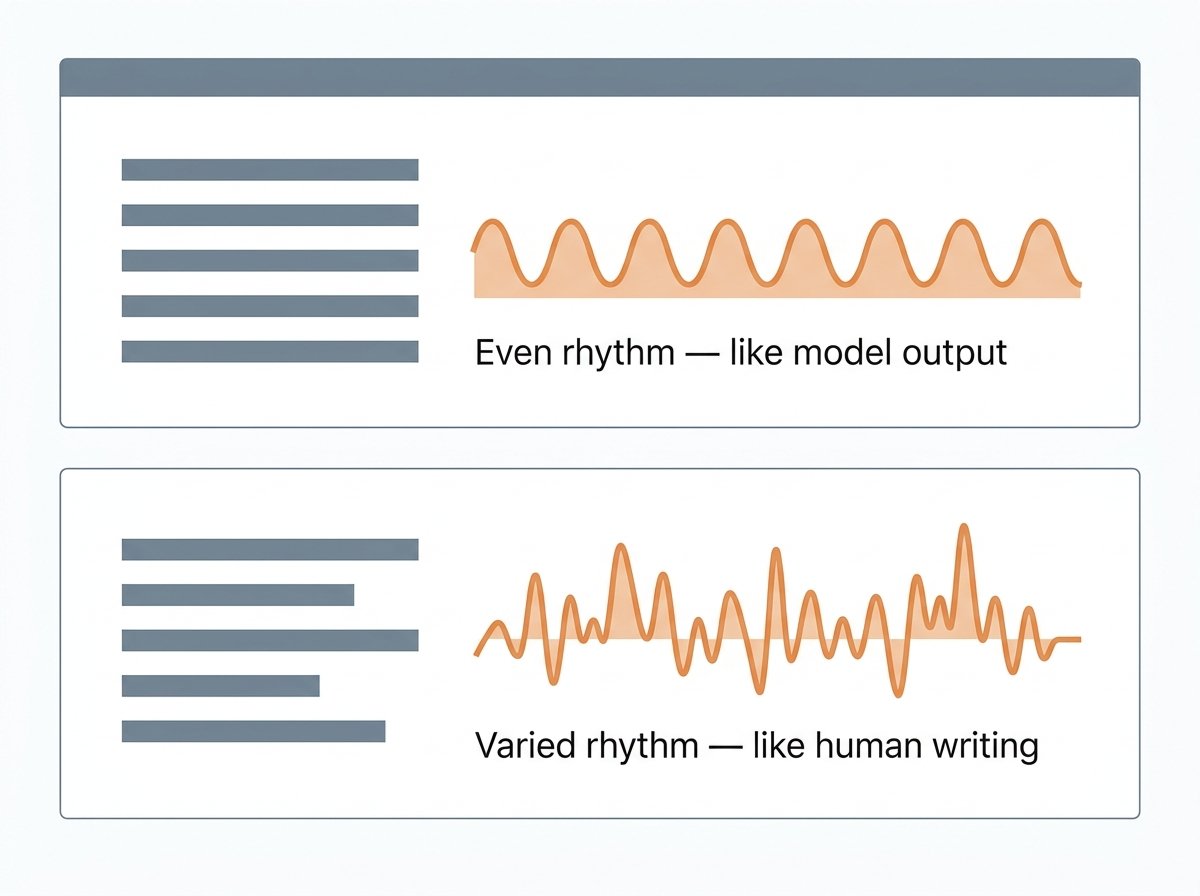
The difficulty is that these signals describe the text itself and say nothing about the writer’s intent. A student who writes cleanly and formulaically, with clear structure, even rhythm, and careful word choice, can look statistically identical to model output. A human who has edited, paraphrased, or prompted a model can look statistically identical to a human. Detectors score only the surface of the writing, which is why every serious vendor frames a score as one signal rather than a final decision.
For the technically curious: perplexity is computed from the negative log-probability of a token sequence under a reference model, usually normalized per token. Modern detectors are trained classifiers built on top of features like this rather than raw likelihood ratios, and the foundations for that block live in our beginner’s guide to deep learning.
Text watermarking, which steers a model’s word choices so that its output carries a detectable statistical fingerprint, was proposed as the stronger mechanism. Early research found that watermarks can be defeated by simple paraphrasing, which is why no detector in this list relies on them as of November 2026.
The 2026 detector landscape
The short list is shorter and more consolidated than the 2024 one, because the market has been through a shakeout. Content at Scale, whose AI Detector Pro appeared in the earlier version of this post, has rebranded to BrandWell and folded its writing tools into a broader growth-automation product, and the old detector page is gone from any site.
Winston AI now lives at gowinston.ai rather than the domain it was known under, a move that quietly stranded anyone with an old bookmark. Copyleaks, which has aimed at enterprise and hiring use cases, remains an option for organizations, although we could not independently verify its current terms during the research for this refresh.
The acquisition of GPTZero matters more for distribution than for branding. Its reported scale at the time, more than 19 million registered users and $30 million in annual recurring revenue, had already made it a business rather than a benchmark (Business Insider, 2026). Superhuman’s chief executive also told the same outlet that his company reaches 40 million daily users, with education accounting for roughly a third of the more than $700 million in annual revenue around its flagship Grammarly product, so the detector now has a delivery channel that no standalone startup can match.
| Tool | Who it’s for | Free tier | What changed, 2024–2026 |
|---|---|---|---|
| GPTZero | Teachers and institutions — the company says 3,500+ colleges | Scans under 10,000 characters | Acquired by Superhuman (June 2026); sentence-level explanations; ESL false-positive reduction (vendor claim) |
| Turnitin Clarity | Institutions, via campus licenses | None — institutional subscription | AI detection folded into “Clarity” — “don’t just detect AI, understand it” (company site) |
| Originality.ai | Publishers, agencies, individual students | 100 free credits (10K words) | Originality 5.0 and 5.0 Max return AI / human / mixed scores; Writing Replay authorship tool |
| Winston AI | Education and SEO teams | Free account | Now at gowinston.ai; claims #1 on the RAID benchmark (vendor claim) |
| Quetext | Students and small teams | Free tier | All-in-one “DeepSearch” suite: plagiarism, AI, grammar, summarizer |
| ZeroGPT | Casual users | 15,000 characters free | PDF reports, batch upload, multilingual scanning |
We did not run our own benchmarks on these tools, and we are deliberately not ranking them against one another. The accuracy figures that follow are either vendor claims, which we label as such, or the results of a single named independent test, and the gap between those two sources is the defining story of this entire category.
You can use the table as a map of who is who in 2026, although it was never built to work as a scorecard. Our AI reviews hub explains how we evaluate and link tools across the site in general.
Where to try each detector
Each of the five tools above is linked below, along with a short summary of who it suits best.
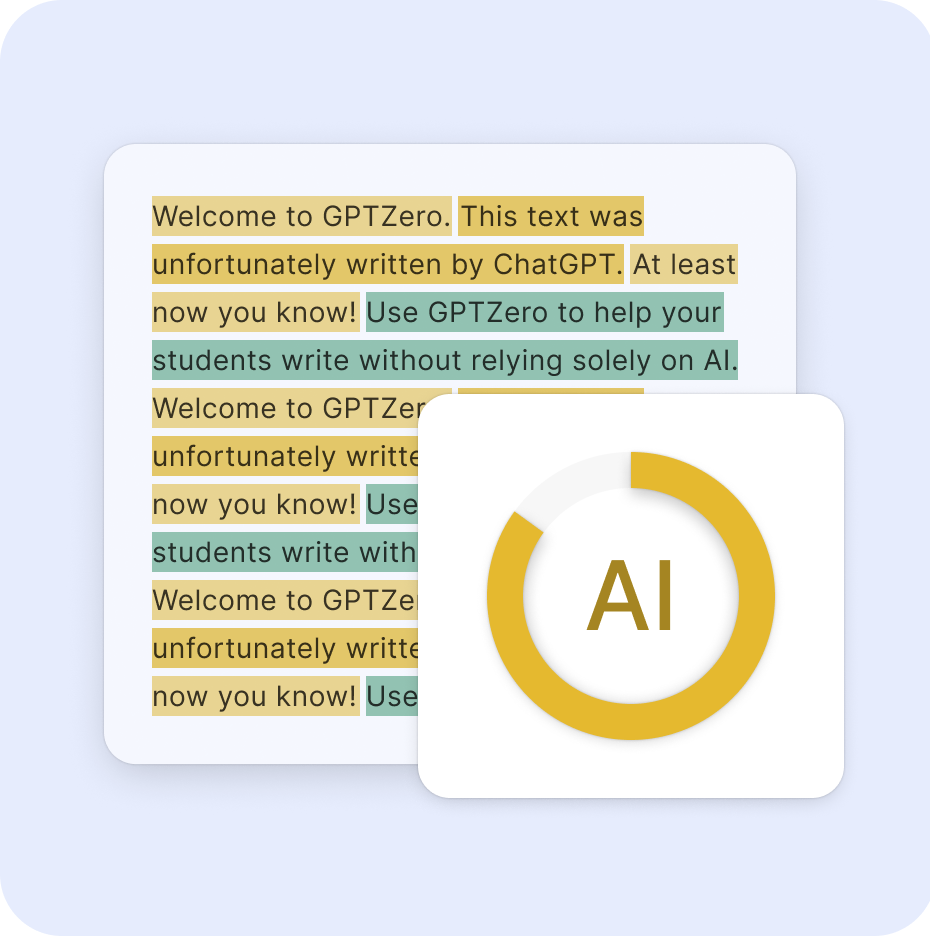
GPTZero is the scale leader in this space, reporting use in 3,500+ institutions and more than 19 million registered users, and its sentence-level explanations make a flagged result easier to discuss, or overturn, with a student. Free scans run to 10,000 characters with no account needed. As of November 2026, GPTZero is running a limited-time holiday promotion, so check the site for the current promo code before you pay full price.
Originality.ai is the pick for publishers and agencies, and it offers a free 100-credit trial, about 10,000 words, before any payment is required. Its 5.0 models return separate AI, human, and mixed scores, which is the most granular breakdown in this list, and choosing annual billing rather than monthly saves up to 23% on top of the free credits.
Click here to try Originality.ai.
Winston AI targets education and SEO teams, offers a free account, and is the only tool in this list that claims the top position on the RAID benchmark, which remains a vendor claim but at least one tied to a named benchmark. As of November 2026, a limited-time promotion applies 50% off all paid plans with code WINSTON50, and the prices shown on their site already reflect that discount.
Quetext is the all-in-one option, because a single suite covers plagiarism, AI detection, grammar, and a summarizer, which makes it the practical choice for students and small teams who would rather pay for one tool than three, and a free tier is available. Quetext is also running public offers right now: 40% off is badged on the Essential plan, and bundling the plagiarism checker with the AI detector saves up to 45%.
Click here to see Quetext pricing.
ZeroGPT remains the most generous free option, with 15,000 characters per scan, PDF reports, batch upload, and multilingual scanning. It has no public affiliate program, so the link below is a plain one. It works well as a first pass, although you should never let it settle a consequential decision on its own.
Click here to scan free with ZeroGPT.
What the accuracy numbers actually mean
Every vendor says it has solved this problem, and the numbers on their homepages appear to back that up. GPTZero claims 99.9% accuracy, Winston claims 99.89% of AI text detected at a 1% false-positive rate on the RAID benchmark, and Originality.ai claims 99%. Every one of those figures is a vendor claim, and the same pattern repeats across the category.
At least two of the vendors maintain roundups of third-party studies on their own blogs, which means the category is running an arms race of accuracy marketing. As a result, the most impressive number in the room is usually the one printed by the company selling the tool.
The clearest independent data point we could verify for 2026 is a 200-sample test published in June 2026 by aibusted.com. It scored GPTZero at 83% on detecting AI text, an 11% false-positive rate on human text, and 68% on mixed human-and-AI documents. Because the site sells a competing product, you should read those numbers as one data point rather than a verdict.
The most instructive anchor in the whole category is not a benchmark at all. OpenAI, which had both the models and the data, shut down its own detector in July 2023, and Ars Technica reported that the reason was accuracy too low to be useful (Ars Technica, 2023).
Where the numbers do agree is on the general shape of the problem, which stays consistent across vendors. Detection works well on clean, unedited, full-length samples from models the detector was trained on, and that is a narrower slice of real writing than the marketing suggests.
Accuracy degrades sharply on paraphrased, mixed, or short text, and it degrades most of all for writers whose prose is already more predictable than the training data expects, which is where the fairness issue begins. For broader context on how detection fits into the education ecosystem, our learn hub collects the related reading.
The fairness problem nobody prices into
A 2023 study by Weixin Liang, Mert Yuksekgonul, Yining Mao, Eric Wu, and James Zou, published in Patterns and available on arXiv, tested seven widely used GPT detectors on 91 TOEFL essays by non-native English writers and 88 US eighth-grade essays from an automated-scoring dataset. The detectors were near-perfect on the native-speaker essays but misclassified more than half of the authentic TOEFL essays as AI-generated, at an average false-positive rate of 61% (Liang et al., 2023). The same study showed that simple prompting strategies let writers bypass the detectors entirely, so the tools penalize constrained writers while skilled cheaters slip through, which makes the failure one of fairness in both directions at once.
For a classroom, the implication comes down to simple arithmetic. At the 11% false-positive rate measured in the 2026 test, a class of thirty honest students could produce roughly three false alarms in a single assignment, and the writers most likely to be among them are often the ones with the least power to defend themselves.
Vendors have responded in part, and the current generation does better on the same 91-essay set. Originality.ai reports 98.9% human specificity on its 5.0 model and 100% on 5.0 Max, though these are vendor-published numbers on a benchmark of the vendor’s own choosing. GPTZero likewise says it trains explicitly to hold false positives on English-as-a-second-language writing near 1%, which is a vendor claim rather than a measured result. Because the bias stems from the statistical approach itself, a software patch is unlikely to remove it entirely.
If you want the foundations of how these models learn in the first place, our beginner’s guide to machine learning covers that ground.
What a trained eye catches
Intuition is still a legitimate first instrument, and the cues experienced teachers describe deserve serious attention even though they are hard to formalize. A sudden jump in quality, a change in voice, or a paper suddenly longer and cleaner than anything in the student’s history can each justify a conversation, although none of them counts as evidence by itself.
The mistake to avoid mirrors the detector mistake, because both kinds of error are easy to feel certain about. A detector errs statistically while a hunch errs through pattern-matching, and either one can be confidently wrong about an honest student. What turns a hunch into something actionable is corroboration, such as a second tool’s result, an earlier draft, or an oral defense in which the student walks you through their own work.
We keep the original post’s hunch-based framing because it remains the most defensible approach, in which detection starts the conversation and the student’s own evidence ends it.
The workflow that protects honest students
The workflow below is what separates responsible use of these tools from misuse, and it applies whether you are grading an essay or reviewing a client’s content.
- Treat the score as a trigger, not a verdict. If a paper flags high, your next step should be a conversation and an investigation rather than a penalty. The vendors who know their own tools best, including Originality.ai in its own FAQ, give the same advice.
- Corroborate before you act. Run the text through a second, different detector and compare the results. Agreement between two tools tells you more than either score alone, and disagreement is itself a signal worth recording.
- Collect process evidence. Drafts, version history, in-class writing samples, and an oral defense all count as authorship evidence. A student who can explain their own reasoning has made your job considerably easier.
- Assume a false positive is possible from the start, especially for non-native English writers and for structured, formulaic assignments. Set your policy’s burden of proof so that it reflects that risk.
- Follow your institution’s policy, in writing, before any consequence happens. A detector’s output should feed into the process as one input and should never stand as its finding.
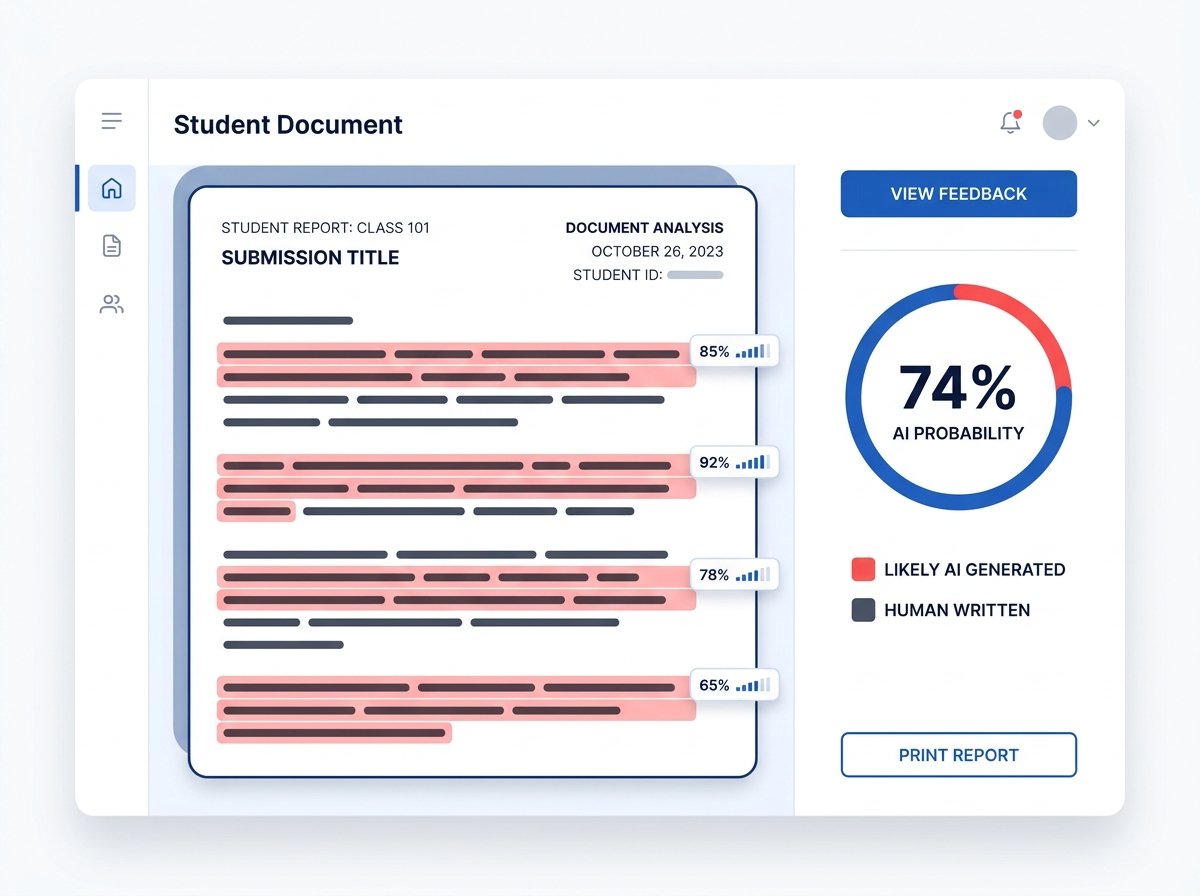
The strongest objection to all of this is also a fair one, since institutions still need some way to enforce academic integrity if a detector’s output cannot be trusted. The answer is that the burden of enforcement has to shift from detection toward assessment design.
Process-based work such as in-class writing, staged drafts, and oral defenses turns detection into a backstop instead of a first line of defense. A detector’s real value is that it gives a teacher a reason to start a conversation that process-based work alone might never trigger. If you are cataloging the tools you trust for a workflow like this, our AI tools directory is a useful place to start.
Questions readers ask
Is there a free AI detector that is actually reliable?
ZeroGPT is the most generous free option at 15,000 characters per scan, and GPTZero allows scans under 10,000 characters without an account. The free tier, however, is exactly where the false-positive problem is most pronounced. If the outcome of a scan would matter to a person, treat the free result as a first pass and confirm it with a paid tool or a second opinion.
Can detectors still catch ChatGPT, Claude, and Gemini output in 2026?
They can, at least for clean, unedited text from the models each vendor has recently trained on, and GPTZero says, for example, that its current model was updated with GPT-4.1, o3, Gemini 2.5, and Claude Sonnet 4 output. The gap opens the moment a human edits, paraphrases, or blends the model output with their own writing, which is precisely where the 2026 independent test found the biggest drops in accuracy.
Which detector should a single teacher use?
If your institution licenses Turnitin’s Feedback Studio with the Clarity AI-detection add-on, the answer is Turnitin Clarity, because the score lives inside the grading workflow you already use. If you are working alone, the practical setup in 2026 is a free first pass on GPTZero or ZeroGPT, followed by a second opinion from a different vendor before anything consequential happens to a student or a client.
What should I do if a student’s essay flags as AI and the student insists it is theirs?
Corroborate first, with a second detector, earlier drafts, and an oral defense of the student’s own work, and then follow your institution’s documented process, in writing, before any consequences are applied. The fairness research on non-native writers is the reason your default response should be to investigate rather than accuse. Most honest false-positive cases resolve within that investigation rather than after it, once the student can show their process.
Will detection get good enough to rely on eventually?
As of November 2026, nobody can tell you with confidence. The two forces shaping the answer, models getting better at sounding human and detectors getting better at finding the tells, are locked in a continuing race, and the vendors with the most to say in favor of a yes answer are the same ones selling the detectors.
Watermarking research points in a promising direction but has not yet held up against paraphrasing, so the part you can plan for today is the workflow around the technology.
The bottom line
AI cheating detection in 2026 is a real, improving, and fundamentally bounded tool. It works well as a screening instrument, it fails predictably for the people who least deserve to be flagged, and every serious vendor advises using it as one signal among several rather than as a verdict. The workflow that holds up under those conditions is the same whether you are a teacher or an editor: detect, corroborate, investigate, and act only on the process. If you are an educator looking to redesign assignments so that the question matters less, our guide to using AI in education is the natural next read.
A note on links: this post contains affiliate links to the services above. If you decide to make a purchase, please go through those links where you can, since it costs you nothing extra and helps keep this site running.