Table of Contents
- How was the free-model test designed?
- How many AI models are actually free to use?
- How often did free endpoints fail to answer at all?
- How accurate were the answers that did arrive?
- Why do free models take so long to reply?
- Does a bigger model mean a more trustworthy one?
- What can you safely conclude from one day of testing?
- How should you plan around a free endpoint?
- What are the short answers to common questions?
- Where does this leave a reader who will not pay?
If you will not pay anything for an AI model, the useful question is what the free tier costs you in availability, waiting and trust, because the zero on the price tag tells you nothing about any of the three. To measure those costs, we sent the same twelve tasks to eight free models on 21 November 2026, three times each, and let software decide whether every answer was right. By the end you will know which free endpoints to test before you trust one, how to tell a refused request from a wrong answer, and why a paid key is worth keeping for anything with a deadline.
Free access is a different service
Most people approach free AI expecting a scaled-down version of the paid experience, with answers that are a little weaker and limits that are a little tighter. Our sweep points somewhere else, because the most consequential failure on the day was a request that came back with no answer at all, and a missing answer demands different habits from you than a mediocre one. Our guide to reading AI benchmark claims explains why that kind of reproducibility is the first property to look for in any published test.
The design was kept small so that it could be repeated and checked. Eight free models each received the same twelve tasks three times, which produced 288 requests, all run between 23:15 UTC on 21 November and 00:40 UTC the following morning. Failed requests were retried after waits of 2, 8 and 30 seconds, up to four attempts each, so the sweep made 609 attempts in total to settle those 288 outcomes. The bill came to $0.00, since every endpoint was on a free tier.
The tasks were chosen so that a program could decide whether each answer was correct. They covered document field extraction, structured JSON output, multi-step arithmetic, unit conversion, fixing code against a supplied test suite, writing SQL against a fixture database, computing CSV aggregates, obeying hard instruction constraints, long-context retrieval, faithful summarization, classification, and calibration against false premises.
No judge model and no human rating appears anywhere in the scoring path. That matters because a model grading another model brings its own preferences into the score, and a person grading hundreds of outputs can drift, whereas a scorer that checks whether a query returns the right rows or whether code passes its tests behaves the same way every time. The scorers are themselves covered by 39 unit tests, and re-scoring all 288 stored outputs reproduces the published score column exactly.
The sweep also has a deliberate boundary. It contains no paid models, so it cannot tell you whether a subscription would have done better on the same tasks, and none of the results that follow should be read as a comparison with one.
The free roster is smaller than the marketing implies
When we queried OpenRouter’s model inventory through its /api/v1/models endpoint on 21 November 2026, it listed 476 models. Only 14 of them were priced at zero for both input and output tokens, so the large catalog an aggregator advertises shrinks to a few percent of itself once you filter for models that cost nothing to call.
Six of the fourteen were excluded before testing: two audio models, one 1.7B model too small to be a fair comparison, OpenRouter’s own router, which picks a model for you and so cannot be attributed to one, and two further models left out to keep the roster to eight endpoints within a single day of requests. The eight models we tested were all :free variants that were live on the day: nemotron-3-ultra-550b-a55b, nemotron-3.5-super-vl, nemotron-3.5-lightning, gemma-4-31b-it, gemma-4-26b-a4b-it, ernie-5.5-flash-preview, ling-3.2-flash and flint-v1.0.
Read by family rather than by name, the list is narrower still. Three entries are Nemotron variants and two are Gemma 4 variants, which means five of the eight roster slots belong to just two families, and a free user choosing among them has less genuine variety than the count of eight suggests.
The request caps narrow your options further. OpenRouter’s documentation page “API Credit & Rate Limits”, read on 21 November 2026, sets the limit for :free model IDs at 20 requests per minute and 50 requests per day. That daily ceiling rises to 1,000 requests once an account has purchased $10 of credits, so the most generous version of free use is available only to people who have already paid something.
Fifty requests a day is a workable budget for occasional questions typed by hand. It is a much tighter budget for anything automated, because a script that retries failures makes more calls than its task list implies, and in our own sweep 288 requests took 609 attempts to resolve.
Two of eight endpoints never answered a single request
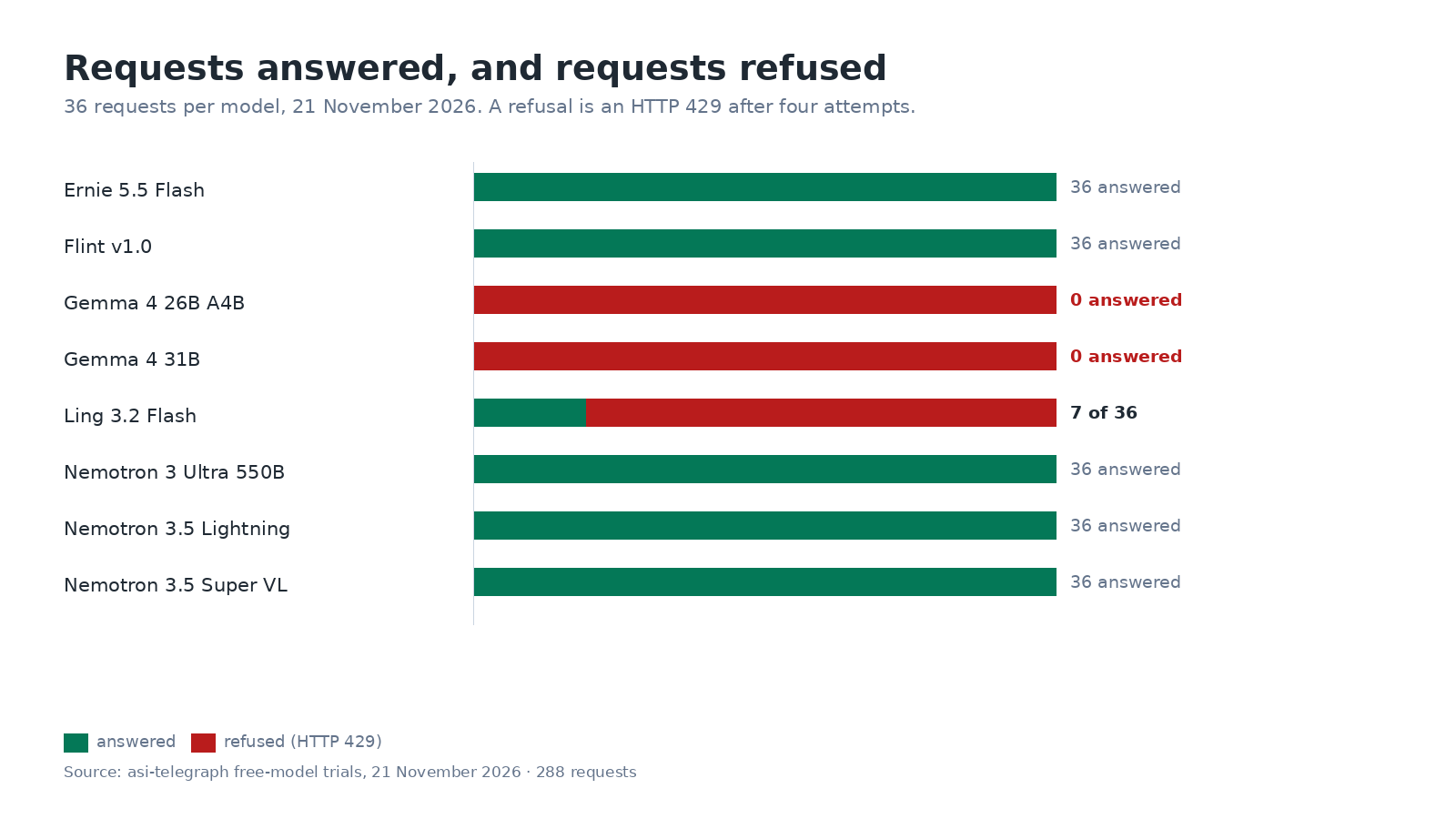
Availability was the first thing that decided whether work got done. In the sweep we ran on 21 November 2026, 101 of the 288 requests, or 35%, ended as HTTP 429 after all four attempts, according to the run log.
A 429 is the status code a server returns when it declines a request because too many have arrived. The message attached to these failures read “temporarily rate-limited upstream”, which indicates that the provider serving the model applied the limit and that nothing in our requests caused it.
The failures were not spread evenly across the roster, which is the most useful thing to know about them. Both Gemma 4 endpoints, gemma-4-31b-it and gemma-4-26b-a4b-it, answered 0 of their 36 requests. ling-3.2-flash answered 7 of 36, or 19%, per the same run log. Those three models account for all 101 failures, because the other five, namely nemotron-3-ultra-550b, nemotron-3.5-super-vl, nemotron-3.5-lightning, ernie-5.5-flash-preview and flint-v1.0, left none of their 36 requests unanswered.
The split was stark: five endpoints held up through every request, two held up through none, and ling-3.2-flash answered fewer than a fifth of the time. On this evening, the model you happened to pick mattered far more for whether you got an answer than for how good that answer was.
We recorded every 429 as unavailable and never as a wrong answer, which is why accuracy and availability are reported separately throughout this piece. The two Gemma results describe what the endpoints did on one evening, and they say nothing about what the underlying models can do when they are served.
For a free user, though, that distinction offers limited comfort in the moment. A model that might score well on paper contributes nothing to the evening you need it if every request comes back refused, and nothing in the free tier warns you in advance which endpoints will behave that way.
On the tasks they could answer, the free models were competent
Once a model answered, it usually answered well. The scores below are a percentage of the maximum, averaged over three runs, listed by effective score, and the order is not a ranking; the “effective” score counts points earned against every request slot the model had, with a refusal scoring zero, which keeps availability failures from quietly disappearing out of the accuracy figures.
| Model | Effective score | Requests answered | Mean latency |
|---|---|---|---|
| nemotron-3.5-super-vl | 100 | 36/36 | 11.2s |
| ernie-5.5-flash-preview | 99 | 36/36 | 3.5s |
| flint-v1.0 | 97 | 36/36 | 47.6s |
| nemotron-3.5-lightning | 96 | 36/36 | 22.9s |
| nemotron-3-ultra-550b-a55b | 95 | 36/36 | 18.5s |
| ling-3.2-flash | 23 | 7/36 | 9.4s |
| gemma-4-31b-it | 0 | 0/36 | — |
| gemma-4-26b-a4b-it | 0 | 0/36 | — |
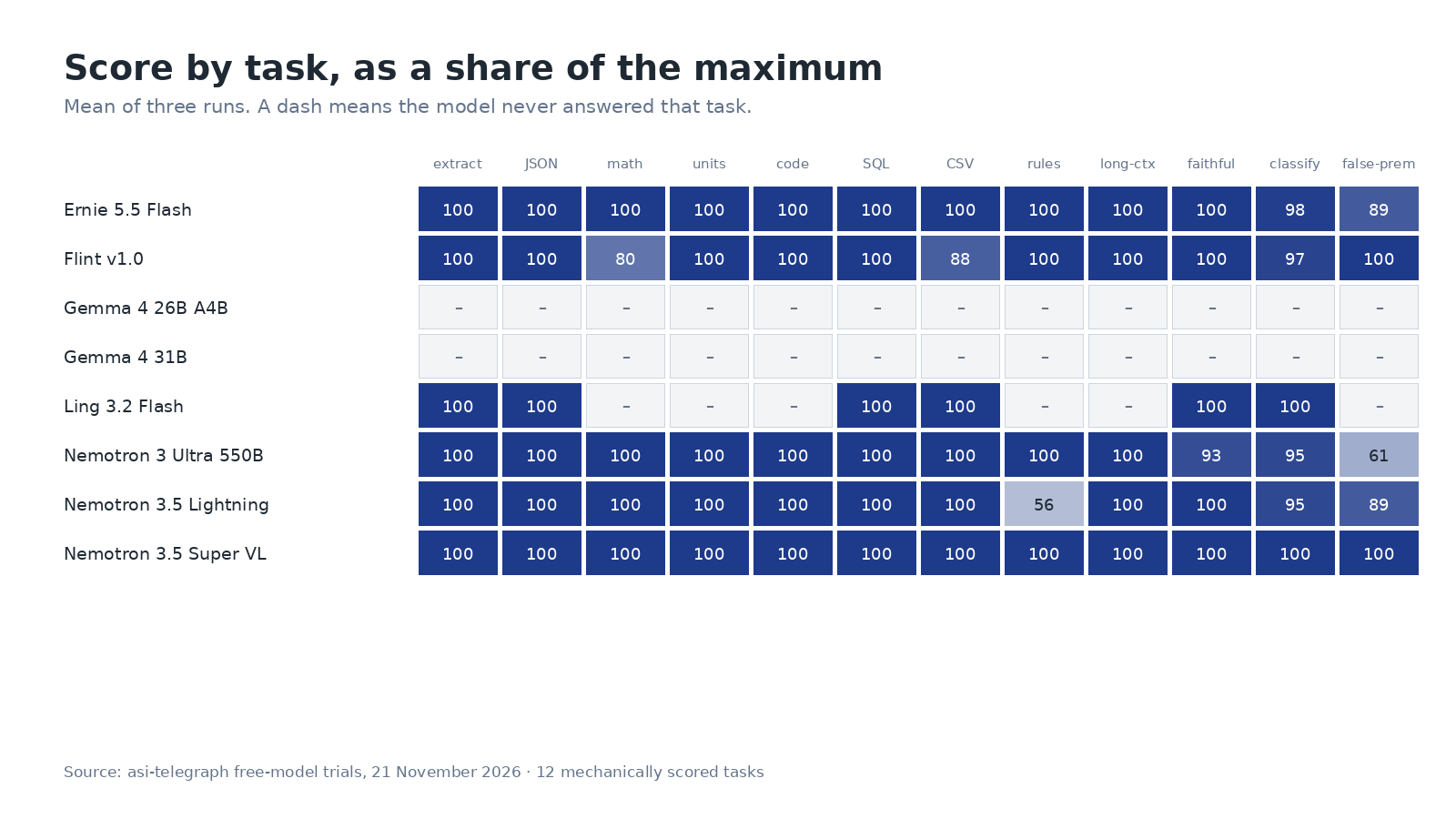
Five models answered all 36 requests, so for them the effective score is also a straightforward accuracy score. nemotron-3.5-super-vl scored 100, ernie-5.5-flash-preview 99, flint-v1.0 97, nemotron-3.5-lightning 96 and nemotron-3-ultra-550b-a55b 95. Both Gemma endpoints scored 0, purely because they answered nothing. ling-3.2-flash answered only seven of its thirty-six requests, so its effective score of 23 says more about how often it answered than about how well it answered.
With aggregate scores between 95 and 100, there was little room left for failure across the mechanical core of the test, which included extraction, structured JSON, arithmetic, SQL and code repair. These are tasks with one correct output that a program can check, and on 21 November 2026 the answering models mostly produced it.
The misses that stand out in the per-task results were narrow, because each one sat inside a single task. nemotron-3.5-lightning scored 56% on hard instruction constraints, because one run fell three words short of the count and another returned nothing at all, having spent its budget thinking. flint-v1.0 scored 80% on multi-step arithmetic, where every other answering model scored 100%, and 88% on CSV aggregates, where the others again scored 100%.
The pattern in those misses is more useful than the scores themselves. A missed word count, a wrong step in a calculation and an off aggregate are all errors that a quick mechanical check exposes immediately, so they are cheap to catch if you check and expensive only if you trust the output unread.
If you want background on what a model is doing when it produces these answers, our beginner’s guide to machine learning covers the prediction process in plain terms.
Most of what you wait for is thinking you never see
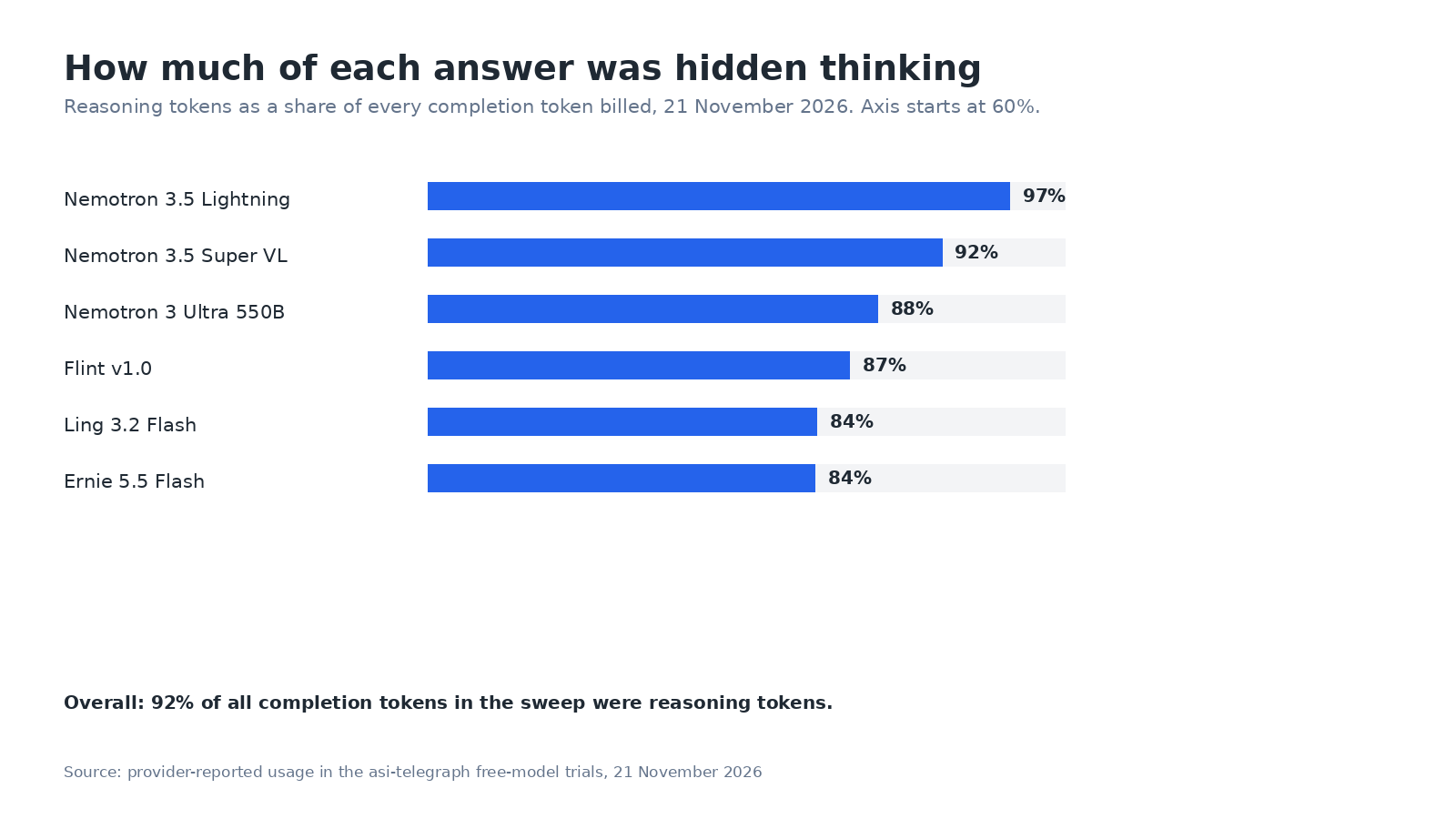
The answers you read were a small fraction of what the models generated. Hidden reasoning accounted for 92% of all completion tokens generated in the sweep on 21 November 2026, or 330,788 of 361,133, according to the token counts recorded in our run data. Reasoning tokens are the hidden working that a model writes before its answer, and they never appear in the reply.
Those tokens are billed and they take time to generate, even though you never see them. The share varied by model, and nemotron-3.5-lightning spent 97% of its output on hidden reasoning, followed by nemotron-3.5-super-vl at 92%, nemotron-3-ultra-550b at 88%, flint-v1.0 at 87%, and both ernie-5.5 and ling-3.2-flash at 84%.
In our sweep, truncation came from hidden reasoning: a model that spends its whole budget thinking runs out before it writes an answer, so the reply arrives empty. In our sweep, 141 of 288 requests needed the token cap raised to 4,096 before they produced any answer at all.
Some needed far more. Twenty-nine requests still produced nothing at 4,096 and were re-run once with a cap of 16,384: 22 answered, six were refused outright and one produced nothing even then. That last one was a constraints task sent to nemotron-3.5-lightning, and it is recorded as a failure.
The same hidden work shows up as waiting time, and the range was wide. Mean latency per answer was 9.4 seconds for ling-3.2-flash, averaged over its seven answered requests, 3.5 seconds for ernie-5.5, 11.2 seconds for nemotron-super-vl, 18.5 seconds for nemotron-ultra, 22.9 seconds for nemotron-lightning and 47.6 seconds for flint-v1.0. The model with “lightning” in its name was the second slowest of the six that answered, behind only flint-v1.0 at 47.6 seconds.
The largest model was the worst at refusing a false premise
One result in the sweep cuts against the common assumption that a bigger model is a safer choice. nemotron-3-ultra-550b scored 61% on the false-premise task in the sweep of 21 November 2026, per our own scorer output, while every other answering model scored between 89% and 100%.
A false-premise question builds in an assumption that is untrue, such as asking why an event happened when it never did, and the calibrated response is to point out the error instead of answering as if the assumption held. The task measures whether a model will contradict the person asking, which is a different skill from computing a correct number or extracting a correct field.
On every other task it sat within two points of its nearest sibling; on this one it fell 28 points behind the next-worst model. On the mechanical tasks, nemotron-3-ultra-550b scored as well as its smaller relatives, so the weakness appeared specifically where the model had to resist the framing it was given.
That matters more than a single benchmark point would suggest, because the two kinds of error fail in different ways. A wrong extraction or a broken calculation can be checked against the source document or a calculator, whereas an answer that accepts a false premise reads as fluent and confident, and it is most likely to fool you on precisely the questions where you do not already know the facts.
The result should be held at its proper weight. It comes from three runs of one task on one evening, and it describes what this model did under those conditions on that date. Nothing here is a standing property of the model, or of large models in general.
It does, however, undercut one shortcut that free users often take. When the choice is among free endpoints, picking the one with the largest parameter count is a reasonable guess about general capability, but on 21 November 2026 it would have been the worst guess available for the specific job of catching a mistaken question.
What these numbers do and do not tell you
Every figure in this piece is a measurement taken on 21 November 2026, through OpenRouter, which routed the successful requests to four upstream providers (Nvidia, Baidu, Recursive and Ant Digital), across twelve narrow tasks, and it is not a standing claim about any model. Free endpoints, including those in OpenRouter’s free-tier collection, change without notice, so a model that refused every request that evening may answer the next day, and a model that answered everything may not.
The availability results describe service on the day and nothing more. The two Gemma endpoints did not serve a single request, and that tells you what a free user would have experienced, while telling you nothing about how the models perform when they are reachable.
The sweep also supports no conclusion about paid models. Claude, GPT and Gemini Pro-class endpoints do not appear in OpenRouter’s free tier at all, and Google’s Gemini API rate-limit documentation, read on 21 November 2026, shows the free tier returning 0 requests for Gemini 4 Argon and Gemini 3.1 Pro. Whatever a subscription buys you, this test did not measure it.
For the same reasons, we have not ranked the free models. Five of them scored between 95 and 100 on twelve narrow tasks over a single evening, and a ranking built on gaps that small, measured that briefly, would mislead you and would likely be out of date within weeks.
A skeptic could reasonably argue that one evening of rate limits is noise and should not lead the story. The point is fair as far as it goes, because the sweep cannot say whether the same endpoints would have failed on another day. The instability is nonetheless part of what a free user inherits, since endpoints change without notice and you cannot know in advance whether the evening you need a model will be a good one.
How to use a free endpoint without wasting an afternoon
Treat availability as the first thing to test rather than an afterthought. Before you build a workflow around a free model, send it a handful of requests at roughly the time of day you expect to use it, because on 21 November 2026 the difference between a model that answered everything and one that answered nothing was invisible until a request was made.
If a reply comes back empty, raise the token budget before you conclude that the model failed. In our sweep, 141 of 288 requests produced nothing until the cap was raised to 4,096, and most of the 29 that still produced nothing answered at 16,384, so an empty reply often means the model ran out of room while thinking.
Check structured output with a program rather than by eye. Parse the JSON, run the code against its tests, count the words when a limit matters and recompute any figure you plan to rely on, because the misses in this sweep were exactly the kind that a quick check exposes and a quick read overlooks. Our piece on tools that detect AI cheating makes the broader case for mechanical checks over impressions.
Keep a paid option in reserve for anything that matters. Free endpoints suit exploration and low-stakes work, but when a deadline depends on an answer arriving, a fallback key removes the risk of a refused request, and on OpenRouter a $10 credit purchase alone lifts the free-tier daily cap from 50 to 1,000 requests. Our AI tool search tracks which free tiers are currently available.
FAQ
Are free AI models good enough for everyday tasks?
On mechanically checkable work, the ones that answered mostly were. Five models scored between 95 and 100 in our sweep on 21 November 2026. The larger risk was that a model would not answer at all.
Why did a free model return an empty answer?
It most likely spent its whole token budget on hidden reasoning. Raising the cap fixed most such cases in our sweep, which is why an empty reply usually means the budget ran out before the model wrote its answer.
What does an HTTP 429 error mean?
The server is refusing requests because too many have arrived. In our sweep, 101 of 288 requests ended that way after four attempts.
Which free AI model is the best one?
We have not ranked them. Twelve narrow tasks measured on one evening cannot support a ranking that would hold up for more than a few weeks.
Conclusion
If you will not pay, you get models that are capable on mechanical work when they respond, and you accept a real chance that they will not respond, along with long waits caused by reasoning you never see. The practical response is to test availability first, give the model room to think, verify anything structured with a program, and keep a paid fallback for work with a deadline. For the wider context on how these systems produce their answers, start with our guide to generative AI, browse the Learn About AI hub, and follow new free releases in our AI news coverage.
Method note: All figures come from our free-model trials sweep of 21 November 2026, scored mechanically with no judge model or human rating. A 429 is recorded as unavailable, never as a wrong answer. Free-tier request caps are from OpenRouter’s “API Credit & Rate Limits” documentation, and the model inventory is from OpenRouter’s /api/v1/models endpoint, both read 21 November 2026. The paid-only status of Pro-class Gemini models is from Google’s Gemini API rate-limits documentation, read 21 November 2026. The data bundle (288-row JSONL, summary CSV, README and SHA256SUMS) has run-file hash 2833caa5a2904c449abcb52d0796138eb0f0d565a721dcb6248e6acc61ed49db and summary CSV hash 53b2b9c6e279c016c352737874838252c68e1c666655e9cad1cf28431bfe1ecb.